
On this page
ToggleHigh-Efficiency Solutions for Reliable Industrial Power
Lubricated Screw Compressors in Sri Lanka
Compare lubricated screw compressors in Sri Lanka with Vortex Axion. Review fixed-speed, variable-speed and low-noise enclosed options against actual airflow, pressure and production demand. The MAC3 family pages and Vortex Pneumatics capacity guides describe separate equipment options. Book a free site inspection on 0777 123 263 and request the exact offered model’s technical data.


Our Commitment to You
Discuss your requirements for Lubricated Screw Compressors in Sri Lanka with Vortex Axion in Sri Lanka. Call 0777 123 263 or 0117 101 818, or send an enquiry with your site location and equipment specifications.
Selection guide and common questions
On this page: Screw compressors: airflow comes before motor power · Compare screw compressors from 7.5 to 315 kW · Fixed-speed and variable-speed screw compressors · Belt drive, direct drive and low-noise options · Plan the dryer, receiver and pipework together · Screw compressor price and free site inspection · Questions about screw compressors
Screw compressors: airflow comes before motor power
Screw compressors are selected by usable airflow at the required working pressure, operating pattern and system conditions. List the tools or process equipment supplied, their consumption and which ones run simultaneously. State whether demand remains steady, changes between shifts or falls substantially during breaks. This information supports a more useful comparison than choosing by kW or HP alone.
Request the exact offered model’s free-air delivery and power data at the intended pressure. Compressor performance, cabinet size and accessory requirements can differ between models with the same motor rating. Keep MAC3 family specifications separate from Vortex Pneumatics capacity illustrations and ask for the actual technical sheet before ordering.
Compare screw compressors from 7.5 to 315 kW
Use our electric screw compressor size guide to explore individual power classes. Workshop enquiries can start with 7.5 kW, 11 kW, 15 kW and 22 kW pages. Larger factories can compare 30 kW, 55 kW, 75 kW and the higher-capacity guides.
These pages explain selection considerations and quotation requirements. They do not promise that every size is in stock or has identical controls and pressure options. Specify the actual application and confirm availability, delivery, warranty terms and the complete scope with the sales team.
Fixed-speed and variable-speed screw compressors
A fixed-speed configuration may suit comparatively stable demand. Variable-speed equipment can adjust output within its operating range as demand changes. Compare minimum demand, running hours, unloading periods and the manufacturer’s recommended operating range. A variable-speed label alone does not establish savings for every installation.
For systems using multiple machines, review how the controls coordinate loading and standby duty. Oversizing can create unnecessary unloaded operation, while frequent pressure dips may indicate a distribution restriction or leakage. Ask for demand assessment before committing to a larger machine or changing the pressure setting.
Screw compressors: belt drive, direct drive and low-noise options
The drive arrangement is one part of a screw compressor comparison. Consider the complete machine: airflow, efficiency, maintenance access, consumables, controller and the installation conditions. Review the model families above and use MAC3’s official resources to confirm the manufacturer’s current technical information.
Ask about low-noise enclosed screw compressors for workshops near offices or occupied work areas. Compare stated sound levels and measurement conditions for the specific model. Cooling air, room acoustics and vibration isolation influence noise at the operator’s position. Maintain the required clearances and avoid restricting ventilation in an attempt to reduce sound.
Screw compressors, dryers, receivers and pipework
Lubricated screw compressors need an air-quality review suited to the process. Dryers control moisture and filters address specified contamination, while receiver storage supports changing demand and the control strategy. Treatment equipment must be rated for airflow, pressure, inlet temperature and the required outlet condition.
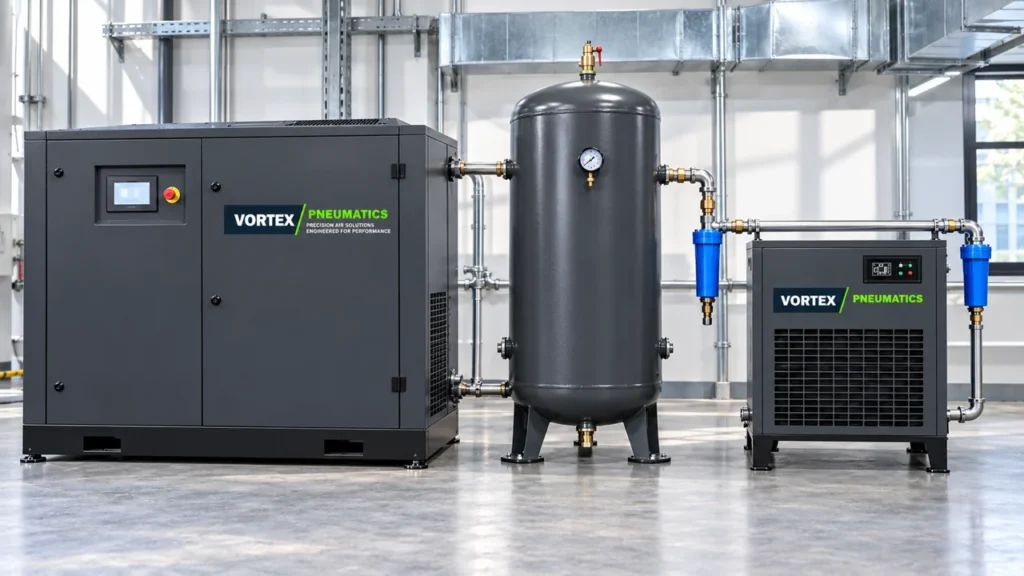
Browse the refrigeration dryer guide when preparing a package enquiry. Ask the supplier to identify filter grades, drainage, receiver volume and the proposed distribution layout. Compressor, tank and dryer images illustrate the package; final connection details and accessory sizes require a site-specific proposal.
Screw compressors: prices and free site inspection
The price of screw compressors in Sri Lanka depends on the exact power and pressure configuration, control type and accessories. Request an itemised quotation in rupees rather than comparing incomplete headline prices. Delivery, taxes, electrical work, pipe installation and commissioning should be identified separately where applicable.
Vortex Axion offers a free site inspection to discuss demand, power supply, compressor location and treatment requirements. Send a tool list, running schedule and photographs of any existing nameplate. Confirm access and the visit timing with our team. Review maintenance planning and spare-parts support before deciding on the package.
Questions about screw compressors
Does motor power tell me the airflow? Not by itself. Compare the selected model’s published delivery at the required working pressure.
Does a price include a receiver and dryer? Confirm the scope. Compressor-only and complete-system offers have different inclusions.
Can screw compressors provide quieter workshop air? Enclosed low-noise options can be reviewed, but request the offered machine’s acoustic data and a suitable installation plan.
How do I request a quotation? Call 0777 123 263 or 0117 101818. Vortex Axion (Pvt) Ltd, 31, 1st Lane, Medawelikada Road, Rajagiriya, Sri Lanka, can discuss the complete requirement.
Build a specification for screw compressors
Prepare a short specification before comparing screw compressors. Include the flow required at working pressure, the daily operating hours, the number of shifts and the pattern of simultaneous demand. Provide the available electrical supply and the location where the machine will operate. If air contacts the product or a sensitive process, obtain the air-quality requirement from the equipment or process supplier.
For an existing workshop, send photographs of the current nameplate and explain when pressure drops occur. Identify the dryer, filters and receiver separately. A larger compressor may not solve a restricted hose or overdue filter service. Reviewing the complete installation helps the proposal address the cause of the complaint rather than only increasing motor power.
Ask the quotation to distinguish essential equipment from optional accessories. Receiver capacity, dryer rating, filtration, drainage and commissioning should be stated. Confirm transport, unloading and electrical responsibilities before ordering. Keep the final specification alongside the offer so any later substitution can be compared with the requirements already agreed.
Service access and ownership requirements for screw compressors
When reviewing screw compressors, consider the servicing needed throughout their working life. Ask for the offered machine’s schedule and consumable references, and confirm support arrangements for your Sri Lankan location. Cabinet panels, filters and major components need appropriate access. A compact footprint should not be achieved by blocking the manufacturer’s service clearances.
Clarify how cooling air enters and leaves the installation. A low-noise cabinet still needs the ventilation specified for that model. If ducting or an acoustic enclosure is proposed, have the arrangement reviewed before installation. The goal is a suitable workplace without creating heat accumulation or restricting routine servicing.
Compare the control proposal with minimum as well as peak demand. Ask how the machine behaves during breaks, quiet shifts and periods of intermittent use. This is especially important where several compressors operate together. Review setpoints and the intended role of storage during handover, then reassess the system when production equipment is added or operating hours change.
Compare screw compressors using model-specific data
Compare screw compressors on the same technical basis. State the intended pressure when requesting airflow and power figures, and ask which accessories are included in quoted dimensions and prices. Manufacturer family names, motor ratings and illustrative pictures are not substitutes for a model-specific technical schedule.
For lubricated screw compressors, confirm the applicable maintenance and lubricant requirements from the documentation supplied for the machine. Ask for dryer and filter operating conditions as part of a complete package comparison. Keep delivery, warranty conditions, commissioning and ongoing service scope visible in the commercial offer so equipment choices can be assessed together with practical ownership needs.
Assess the air network before replacing screw compressors
A pressure complaint should be described at the point where the tool or machine uses air. Record whether the problem affects every user or only a distant branch, and whether it happens continuously or during simultaneous operation. Provide the compressor’s displayed pressure alongside the user-side reading. These observations help distinguish a supply problem from losses across treatment equipment, distribution pipes or local connections.
Include hoses, regulators, quick couplings and filters in the review. A connection that suits one intermittent tool may restrict several users operating together. Ask a technician to assess the network under representative demand before choosing a larger motor. The proposal should explain which restrictions need attention and which measurements support the recommended equipment size.
Identify avoidable consumption separately from production demand. Report audible leaks and equipment that continues using air during breaks. Arrange any leak survey and repairs within the site’s access and isolation procedures. Reducing waste can change the capacity required, but savings should be assessed from actual measurements rather than assumed from a generic percentage.
Compare screw compressors: controls and operating patterns
Ask how the offered screw compressors respond when demand falls. A workshop with long quiet periods has a different operating pattern from a production line with continuous consumption. Discuss starts, stops, unloaded running and the pressure band recommended for the exact machine. Avoid making control changes from general advice; the manufacturer’s instructions and the actual application should guide the settings.
When considering variable-speed control, describe both the lowest sustained demand and the busiest operating period. Request the available operating range and the conditions used for any efficiency comparison. A variable-speed label alone does not establish savings at your facility. Compare proposals using the same flow and pressure requirements, and clarify any restrictions at low demand.
If several machines share one air network, ask which unit provides the steady demand and which responds to changes. Explain any requirement for standby capacity and what happens during servicing. Controls should be reviewed together with storage and distribution. Specify who will configure the system and how operators will recognise a fault or a change in the intended sequence.
Commissioning screw compressors and keeping usable records
Agree a commissioning checklist before delivery. It should identify the supplied machines and accessories, the installation responsibilities and the conditions under which operating checks will take place. Include the production users needed for a representative test. A short demonstration without normal demand may show basic operation while leaving the busiest shift untested.
Keep the model and serial numbers, manuals, quotation, commissioning record and service schedule together. Record the agreed operating pressure and identify the people authorised to adjust controls. Ask for operator guidance on normal starts, stops, alarm reporting and routine observations. Technical repairs, electrical work and pressure-system work should remain with the appropriately qualified personnel.
Clarify consumables and replacement-part references for the offered model. Request the applicable lubricant specification and scheduled maintenance information from its documentation. Do not assume that oil, filters or separators are interchangeable across different screw compressors. Keeping accurate equipment records helps the supplier identify the required items when service is due.
Finally, review the requirement when the business changes. New air users, longer shifts or a different process pressure can alter demand and treatment needs. Update the equipment list before ordering an additional machine. Call Vortex Axion on 0777 123 263 to arrange a free site inspection and discuss the revised operating brief, installation scope and quotation.
For replacement projects, explain whether production can stop during installation. Identify any temporary-air requirement, access restrictions and the preferred changeover window. Ask the offer to distinguish equipment delivery from the date the system is ready for use. Confirm who removes the existing equipment and whether that work, transport and disposal are included in the agreed quotation.
Screw compressors: compare replacement and expansion projects
Replacing an ageing machine and adding capacity are different decisions. For replacement, collect the current model, pressure settings, operating hours and any available airflow measurements. Describe the faults or limitations that prompted the enquiry. For expansion, identify the added equipment and when it will operate alongside the existing load. Compare screw compressors against that specific duty rather than selecting the next motor rating automatically.
Ask whether the proposed machine will run alone or share a common header with existing screw compressors. If equipment remains in service, the proposal should explain its role and how controls will coordinate demand. A supplier should identify any assumptions about standby capacity, unloading periods and future growth. Keep the application requirement separate from an unconfirmed preference for a particular drive or control type.
Check whether a distribution restriction or leakage is contributing to the problem. Provide pressure observations from the affected equipment during operation, together with readings near the compressor. An upgrade can be appropriate, but a motor-power increase alone cannot establish that a hose, filter or pipework problem has been resolved. Ask how the proposed work addresses the actual production complaint.
Screw compressors: quotation and commissioning checklist
Use the same written specification when comparing offers for screw compressors. Request the exact model, delivered airflow at working pressure, control arrangement, electrical requirements, dimensions and access clearances. List the receiver, dryer, filters and drains separately. Mark delivery, positioning, electrical work, distribution pipework and commissioning as included, excluded or provisional. Record the currency, taxes, offer validity and lead time.
Ask for the operating documents associated with the offered equipment, rather than relying on a family brochure. Where an accessory or model changes during negotiation, obtain an updated technical proposal. Warranty conditions, consumable references and maintenance instructions should relate to the actual screw compressors supplied. The package illustration is useful for discussing the arrangement, but it does not identify the final model or accessory capacities.
Before ordering, agree what site preparations must be complete and who is responsible for them. Coordinate electrical assessment, cooling arrangements, unloading access and the delivery route. Confirm when commissioning can take place after the customer’s site work is ready. A free site inspection helps define the project; the commercial scope of installation and service work should still be stated in writing.
At handover, request model and serial details, manuals, commissioning records and an explanation of the controls. Keep the quotation and support contacts with these documents. Establish who monitors abnormal pressure, moisture or noise and how faults are reported. Qualified personnel should perform work requiring isolation or access to pressurised components, following the manufacturer’s procedures.
Review the first period of normal production against the intended duty. For screw compressors serving variable demand, include breaks and low-load periods in the review rather than judging performance only during one busy task. Any claimed operating-cost improvement should identify the baseline, measurement period and calculation assumptions. Discuss future changes to production before adjusting settings or adding connected loads.