
Precision Engineering for High-Quality Compressed Air
Air Treatment Solutions in Sri Lanka
Select compressed-air treatment for your Sri Lankan facility by required air quality, inlet conditions and flow. Compare refrigeration and desiccant drying options against the specified pressure dew point, then check filtration and condensate handling for the process. A dryer should be sized for the actual inlet temperature, pressure and operating conditions.
Provide Vortex Axion with compressor capacity, working pressure and the point-of-use air-quality requirements. Review the dryer families below and request the specifications for a suitable configuration.
For an air treatment upgrade, identify the person responsible for approving the process specification and the person coordinating installation. If production requirements change, send the revised specification before accepting a model. Keep the agreed requirement with the final offer so commissioning and later maintenance refer to the same expected operating conditions.
On this page
ToggleAir treatment price enquiries in Sri Lanka
Request an air treatment quotation that identifies the dryer, filtration, drains, connections and installation work separately. Give the supplier your compressor model, normal working pressure and the air quality required at the equipment inlet. A price for an unnamed dryer is difficult to compare with a complete treatment package, particularly when the two proposals use different rating conditions.
Ask for the quotation in Sri Lankan rupees, with taxes, transport, lead time and payment terms clearly stated. Confirm the offered model and included accessories before ordering. This category page describes families to discuss with Vortex Axion; it is not a stock list or a promise that every catalogue option is immediately available.
If you are replacing equipment, send photographs of the nameplate and pipe connections as well as any existing documents. Describe why you want the change: water at a tool, an air-quality requirement, production expansion or unreliable operation. These are different enquiry triggers and should lead to a proposal that addresses the actual requirement.
Start air treatment selection with the process requirement
Write down where compressed air is used and what the equipment manufacturer requires. A general workshop tool, a spray-finishing process and a quality-controlled production line may have different specifications. Ask your production or quality team to approve the requirement before suppliers select equipment, rather than treating a catalogue description of clean air as a complete specification.
Use a stated air-quality specification where the process requires one. MAC3’s manufacturer air-quality guide distinguishes particles, water and oil. Ask the proposal to address each relevant contaminant and explain where the stated result is expected. A dryer selection alone should not be presented as certification of the complete distribution system.
Document whether air contacts a product, operates an actuator or serves another purpose. Include the point of use and any existing quality records. For specialised applications, confirm the assessment and testing responsibilities with the relevant technical team. This page does not claim suitability for breathing air, medical use or a regulated process.
Air treatment: pressure dew point and dryer choice
Pressure dew point is a useful part of the moisture specification for air treatment. MAC3’s dryer selection guidance links the drying method to required purity and pressure dew point. Request the selected model’s documented performance at your conditions, rather than transferring a family headline to every installation.
Tell the supplier where the pipework runs and the conditions the process will encounter. Include indoor and exposed sections, any temperature-sensitive equipment and the operating schedule. Ask how the proposed drying performance relates to the stated requirement and whether further information is needed before selection.
Keep the requirement distinct from a general description such as dry air. The quotation should state the target, the supplied equipment and any assumptions. Where verification is required, agree the method, location and responsibility before commissioning so the expected result can be assessed consistently.
Refrigeration dryers in an air treatment package
Discuss a refrigeration dryer where that technology can meet the specified moisture requirement. Ask for the exact model, its rated flow and the correction information needed for your inlet temperature, pressure and ambient conditions. The compressor’s kilowatt class is useful background information but does not, by itself, establish the required dryer size.
Confirm the arrangement of filters, drains and connections in the quotation. Ask what is built into the offered dryer and what is separate. Include the electrical supply, service clearance and proposed location in the site review. These practical details can affect whether an otherwise suitable model is straightforward to install and maintain.
Read our refrigeration dryer enquiry guide for more detail. Use the same requirement sheet when comparing quotations so that different suppliers are pricing a comparable treatment duty and installation scope.
Thermal mass dryers for air treatment
The thermal mass dryer family is another option to discuss within the air treatment range. Request the current manufacturer’s data for the offered model and an explanation of its suitability for your operating schedule. Ask how performance and power consumption have been assessed for the actual application.
Give the supplier information about periods of normal demand, light demand and shutdown. Include the expected inlet conditions and any restrictions on the plant room. A general energy-saving description should not be used as a guaranteed saving for your site without an identified basis of comparison.
Ask the quotation to separate equipment features from project-specific estimates. If two dryer technologies are being compared, request their assumptions in the same format, including operating hours, expected load and the supplied accessories. This makes the proposal easier for your purchasing and maintenance teams to review.
Desiccant dryers for air treatment
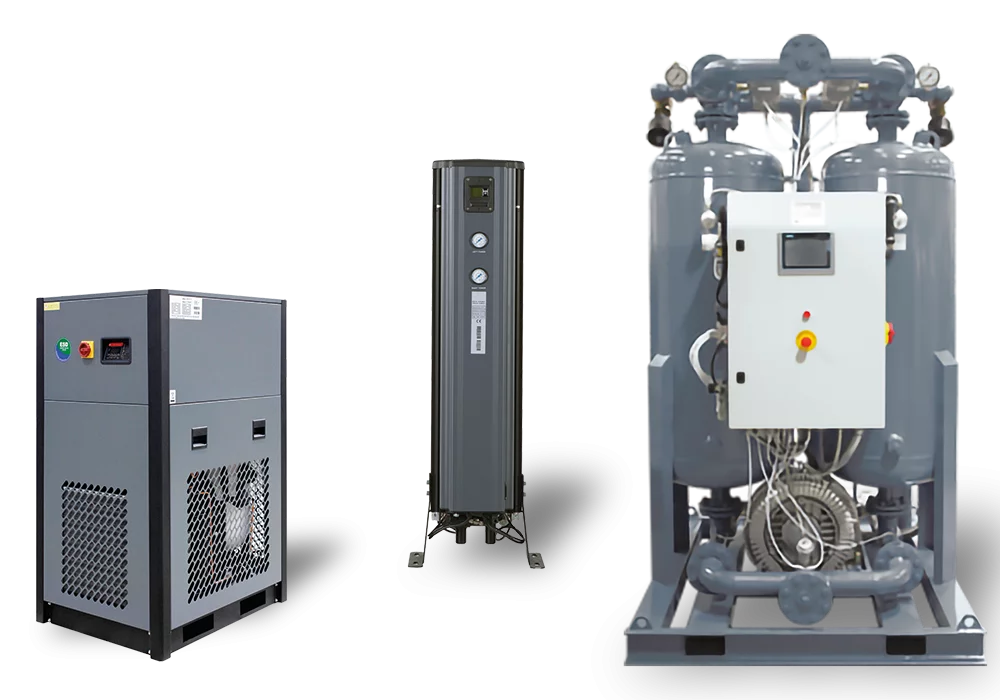
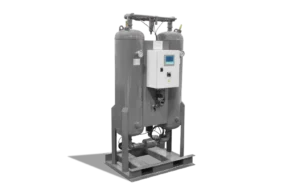
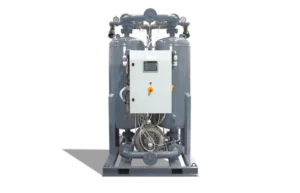
Where the required drying performance calls for a desiccant option, discuss the modular, heatless and externally regenerated families shown above. Ask for the proposed model’s performance, regeneration requirements, controls and maintenance instructions. Choose from the application’s specification rather than the appearance or cabinet size of the equipment.
Request an explanation of any compressed-air consumption associated with regeneration and how it has been included in the package assessment. Confirm the electrical requirements and the relevant operating limits for the offered equipment. These details belong in the proposal, not in an assumption that every dryer family behaves identically.
Check the supplied filtration arrangement and the service access needed for the selected dryer. Ask which consumables require replacement and how the manufacturer specifies that work. Confirm who will maintain the equipment after commissioning and how the process requirement will be checked where verification is part of your project.
Air treatment sizing at the actual operating point
Supply the compressor’s delivered airflow at the intended operating pressure, together with the demand profile. Ask which rating conditions the proposed dryer uses and what corrections have been applied. A catalogue flow number should be accompanied by its conditions so that it can be compared fairly with another model.
Record inlet air temperature and ambient conditions where information is available. If those values are unknown, ask what measurements or assumptions are needed before final selection. Tell the supplier about unusually hot rooms, restricted ventilation or changes between production shifts.
Include realistic future additions separately from the present duty. Ask the proposal to state which expansion allowance is included and what would trigger a new assessment. This helps prevent an unexplained oversize choice or an under-specified system being accepted simply because it has a familiar motor-power label.
Filters and the complete air treatment arrangement
Ask for an identified filter schedule that relates to your stated air-quality requirement. The schedule should make clear which elements are included, their documented role and the service information for the offered models. Confirm whether existing filters will be retained, replaced or assessed as part of the project.
Discuss the connection sizes, installation locations and access for element replacement. Where pressure loss is material to the proposal, request the basis used and how the system will be checked after installation. Ask for instruments or maintenance indicators to be identified where they are part of the offered package.
Keep the compressor choice, dryer and filtration assessment connected. An oil-free compressor description should not be treated as proof of every aspect of delivered air quality. If the process has a specific acceptance requirement, ask the supplier and your quality team to agree what evidence is needed for the complete arrangement.
Drains and condensate handling for air treatment
Include all required drains and the condensate route in the air treatment quotation. Ask which items are supplied with the dryer or filters and which are separate. The scope should identify connection work, operating instructions and the people responsible for routine checks.
Explain the existing collection or treatment arrangement at your premises. Ask whether changes are needed for the offered package and who will confirm the appropriate handling method. Do not leave a drain connection as an unspecified task between the equipment supplier and your piping contractor.
At handover, ask the maintenance team to review the supplied instructions and locate the service items. Keep the accessory details with the plant documents. If a drain or another component is unreliable, record the symptom and arrange an assessment using the actual model information.
Air treatment, receiver tanks and package layout
Review storage alongside air treatment when preparing a new compressor package. Ask the supplier to show the intended locations of the receiver, dryer and filters on a drawing and explain the arrangement for your process. A photograph is useful for orientation but is not a substitute for a project-specific pipe layout.
Provide a room sketch that includes doors, access routes, existing equipment and the proposed installation position. Confirm maintenance clearance and space to remove or replace service items. A layout that fits the equipment footprints may still be difficult to maintain if connections or panels are obstructed.
Use our air receiver tank selection guide for the storage enquiry. Request one coordinated package proposal where several components are being changed, with clear responsibility for each connection and commissioning activity.
Air treatment review when water reaches the point of use
If water is being found at a tool or production machine, explain where and when it appears. Note the dryer model, compressor operation, recent service work and any change in demand. Include available readings and photographs without assuming that the only possible solution is a larger dryer.
Ask for an assessment of the relevant system rather than ordering equipment from one symptom. The review should identify what has been observed, what remains uncertain and which further checks are needed. Provide information about filters, drains and pipework as well as the dryer itself.
Agree the proposed corrective work and how its result will be assessed under representative production conditions. Where process quality is affected, involve the responsible quality team. Keep the findings and any revised equipment specification with the quotation so that the reason for the work is clear.
Air treatment maintenance and operating costs
Ask for a maintenance schedule for the offered package and an itemised list of consumables. Confirm the service contact, required model details and the manufacturer’s instructions. A quotation should help you understand both the initial purchase and the practical responsibilities after installation.
Where operating cost is important, request an estimate with stated assumptions. Include your production hours and load pattern, and ask the supplier to explain which costs are included. Treat estimates of electricity, regeneration demand or consumables as project-specific calculations rather than universal savings claims.
Discuss downtime constraints before choosing a maintenance arrangement. Tell the supplier which production periods are available for service and whether access is restricted. Ask how inspection and replacement work will be coordinated, and confirm the scope separately from any equipment warranty.
Free site inspection for an air treatment enquiry
Ask Vortex Axion about a free site inspection for your Sri Lankan premises. Send the site location, working hours, compressor details and a short description of the required result. Agree an appointment and scope with the team before expecting a visit.
Prepare existing documents, photographs of the equipment and an outline of the production schedule. If there is a specific air-quality requirement, have that specification available. Tell the team about access restrictions and whether production can stop for observations or checks.
A preliminary inspection is different from a detailed energy audit, specialist testing or certification. Ask what is included and what would need a separate quotation. For measured demand and a wider system review, see our compressed-air energy audit page.
Comparing proposals and preparing for installation
Give all suppliers the same requirement sheet for air treatment. Compare the identified dryer technology, rated conditions, filter schedule, drains, controls and installation boundaries. Ask for clarification when one offer contains an equipment-only price and another includes connection work.
Confirm who provides electrical work, piping, supports, transport, unloading and commissioning. Check the proposed dates against your production schedule and arrange any shutdown in advance. Request drawings and dimensions early enough to review the location before equipment is dispatched.
Agree the handover documents and any acceptance checks before ordering. The record should identify the supplied equipment, instructions, drawings and maintenance responsibilities. Keep changes agreed after the site visit with the final quotation so the installation team works to the current scope.
Air treatment frequently asked questions
Is a dryer selected only from compressor kW? No. Provide delivered airflow, pressure, inlet conditions and the required drying performance. Ask for the selected model’s rating basis and corrections rather than assuming every compressor in a power class needs the same dryer.
Do I need refrigeration or desiccant drying? State the required air quality and process conditions first. Request an explanation of the proposed technology and its documented performance for your application.
Can I buy a dryer separately? Yes, you can request a separate quotation. Include the existing compressor, connections, filtration and drainage details so the supplied model can be assessed in the context of your system.
Does an air treatment package guarantee process compliance? A general package description does not establish that. Agree the actual specification, relevant documents, testing responsibilities and acceptance requirements with your technical and quality teams.
Are every model and accessory available locally? Availability and lead time are confirmed for the actual enquiry. Ask Vortex Axion to identify the offered model and supplied items in writing before ordering.
Can you look at an existing installation? Send your location, equipment nameplates, photographs and the issue you want reviewed. Ask about a free site inspection and whether further measurements or specialist work need a separate scope.
Request air treatment guidance from Vortex Axion
Contact Vortex Axion (Pvt) Ltd for air treatment enquiries in Sri Lanka. Explain the process requirement, compressor details and site conditions, then request a written package quotation. The team can discuss the next step and appointment availability for a free site inspection.
Call 0777 123 263 or 0117 101818. Our address is 31, 1st Lane, Medawelikada Road, Rajagiriya, Sri Lanka. Send your requirements through the contact page.
For a new compressor installation, use the electric screw compressor size guides alongside this category page. Confirm the complete operating requirement and offered equipment in the quotation before making a purchase.
Our Commitment to You
Discuss your air treatment requirements in Sri Lanka with Vortex Axion. Ask about a free site inspection. Call 0777 123 263 or 0117 101818, or send an enquiry with your site location and process specification.