
Looking for an air receiver tank in Sri Lanka? Vortex Axion can discuss storage requirements for your workshop or industrial compressed-air system. Request an air receiver tank price quotation and a free site inspection. This guide helps you prepare the volume, pressure, layout and installation information needed for a useful proposal.
Air receiver tank price in Sri Lanka
The air receiver tank price in Sri Lanka depends on the proposed vessel volume, working pressure, construction, documentation and installation scope. Request a written quotation in Sri Lankan rupees for the exact offered tank. Compare the complete installed arrangement rather than a bare vessel price that excludes valves, drains, delivery or connection work.
Send your existing compressor model, operating pressure, site location and the equipment using compressed air. If you have a receiver already, include clear photographs of its nameplate and connections. Tell the supplier whether this is a replacement, an additional storage vessel or part of a new compressor package. Each enquiry requires a different scope.
Ask the quotation to identify taxes, transport, unloading, positioning, accessories, piping, commissioning and any required examinations separately. Confirm availability, lead time, warranty terms and payment conditions before ordering. This page is an enquiry and selection guide; it does not claim that particular tank sizes are in stock or advertise an unverified fixed price.
What does an air receiver tank do?
An air receiver tank stores compressed air and provides a buffer when demand changes. Useful storage depends on both the pressure available and the pressure your equipment needs. It can help a system respond to short demand peaks, but storage cannot make an undersized compressor supply a continuous deficit indefinitely.
Treat the receiver as one part of the complete compressed-air arrangement. The compressor, controls, piping and air treatment still need to match the application. A vessel is not a replacement for an air dryer. For a manufacturer’s general explanation of storage and pressure, see Atlas Copco’s air receiver guide; the final proposal should identify the actual tank being supplied.
How to select an air receiver tank size
Begin with a demand profile, not simply the compressor motor rating. Record which machines operate together, how long demand peaks last, and what happens when pressure falls. Where possible, include measured airflow and pressure over a representative production period. A brief observation during a quiet shift may miss the busiest operating condition.
Ask the supplier to explain the chosen vessel volume using your required operating conditions. The explanation should consider the compressor’s delivered airflow, its control behaviour, available pressure range and the duration of peak demand. A generic litres-per-kilowatt rule should not be the only basis for a purchase.
Give the proposed tank location and available floor space as well. A technically suitable volume may be impractical if it cannot pass through the access route or leaves insufficient maintenance clearance. Request the dimensional drawing before delivery so that the plant team can check height, footprint, connection positions and service access.
Pressure rating and air receiver tank documentation
State the pressure required at the equipment inlet and the compressor’s normal operating settings. Ask for the proposed vessel’s nameplate information and documented operating limits. A tank’s advertised volume does not identify its permitted pressure, temperature range or suitability for a specific system.
The quotation should identify the manufacturer, model and supplied documents. Ask which design or examination requirements apply to your installation and who is responsible for checking them. Do not assume a generic certificate displayed in a catalogue covers the exact vessel, serial number and accessories being delivered.
Have the responsible technical team review protection, isolation, instrumentation and commissioning arrangements before use. Installation, examination and repair requirements should be confirmed for the actual project. This guide does not certify any offered tank or replace the manufacturer’s instructions and a competent assessment.
Vertical or horizontal air receiver tank?
Discuss orientation in relation to the room layout, access route and connection arrangement. A vertical or horizontal description alone does not establish whether a model fits your site. Confirm the manufacturer’s permitted installation arrangement and obtain a drawing that includes supports and the space needed to reach service items.
Check door openings, steps, floor changes and lifting access before accepting delivery. Tell the supplier if the receiver is to be installed on a raised platform or in a restricted plant room. Any supporting structure or anchoring requirements need assessment for the offered vessel and location.
Photographs are useful at the enquiry stage, but they are not a substitute for a site assessment when clearances are tight. Mark the proposed position on a room sketch and include the compressor, dryer, existing pipework and maintenance routes. This helps everyone quote the same physical installation.
Compressor, receiver tank and dryer layout
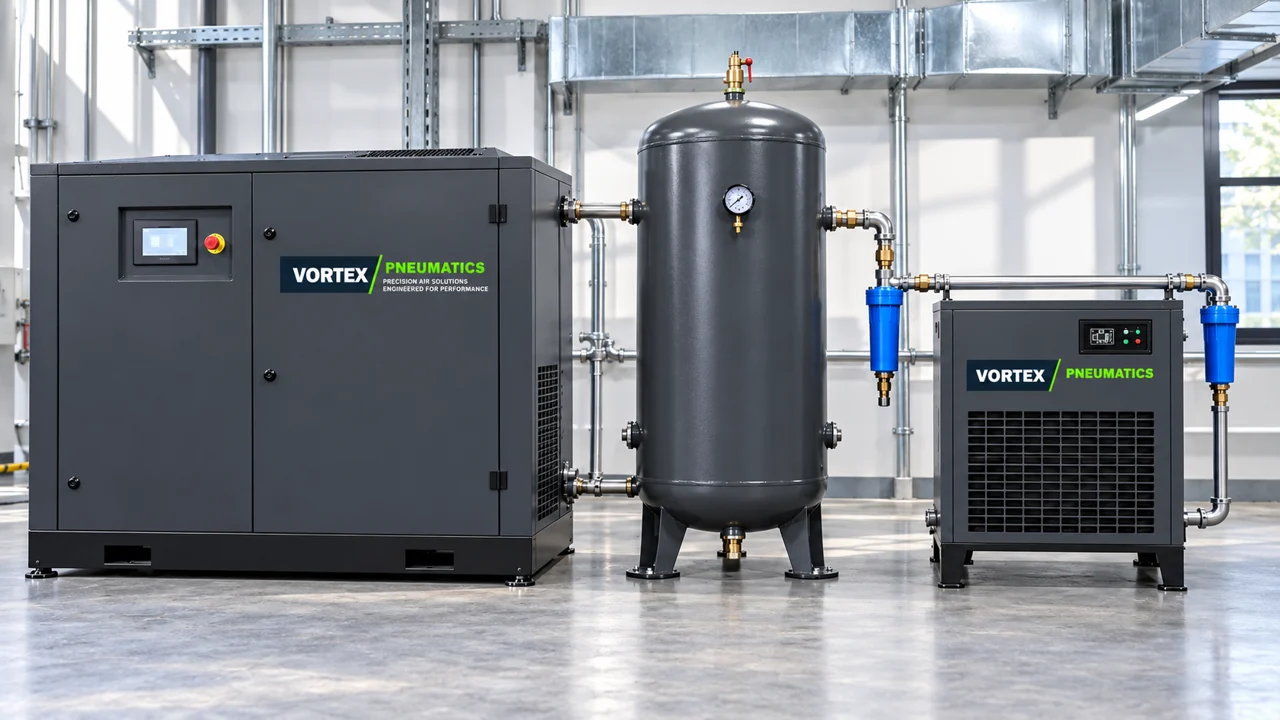
The illustration on this page places the compressor on the left, the receiver in the centre and the dryer on the right, matching the requested visual arrangement. It is an illustration rather than an installation drawing. The final pipe route, storage location and air-treatment arrangement must be confirmed for the chosen system.
Ask the supplier to show whether the proposed storage is before or after treatment and explain why that arrangement suits your application. Where the process has demanding air-quality requirements, discuss the treatment specification and how quality is maintained at the point of use.
Confirm service access around all equipment, not only the vessel. A compact package can become difficult to maintain if a drain, filter or panel is blocked by another machine. Review the drawing alongside the refrigeration dryer guide and ask for a complete package quotation.
Air receiver tank accessories to include in the quotation
Request an itemised accessory schedule for the air receiver tank. Ask which pressure indication, protective devices, drainage arrangements, isolation components and connection fittings are included, and which are supplied separately. The responsible designer should specify the selection and arrangement for the actual vessel and system.
Check that the offered accessories are identified by model or specification rather than described only as a standard kit. Confirm suitability for the stated operating conditions and access for inspection or replacement. Ask who supplies and fits each item so that important responsibilities are not left between contractors.
For an existing system, provide photographs of nearby connections and the pipe layout. Ask whether alterations, new supports or changes to the drain route are needed. A replacement vessel that looks similar may still have different connection positions, dimensions or installation requirements.
Drains, condensate and maintenance planning
Include drainage and inspection access in the proposal. Ask the supplier to explain the specified drain arrangement and the maintenance instructions for the offered tank. Establish who checks the drain, records observations and arranges any required service after commissioning.
Discuss where collected condensate will go and what treatment or disposal arrangement is required for the actual system. Include that work in the quotation instead of leaving it as an informal site decision. Ask for the relevant equipment instructions and identify responsibilities between the supplier and your plant team.
Keep the vessel identification and supplied documents with your maintenance records. Record commissioning information, subsequent examinations and service work as appropriate. If the condition of an existing vessel is uncertain, arrange assessment rather than assuming that a repaint or an external appearance confirms suitability.
Adding an air receiver tank to an existing compressor
Describe the problem you want to solve before choosing a larger vessel. For example, note whether pressure falls during a short tool cycle, stays low throughout a shift, or changes when several production stations operate together. These symptoms may require different investigations.
Provide the compressor nameplate, control settings, running hours and available service history. Include the pressure observed near the compressor and at the affected machine. Ask whether a demand measurement, control review or pipework investigation should precede the receiver selection.
An additional air receiver tank should be assessed as part of the existing system rather than quoted in isolation. Compare the proposed improvement with other identified causes and ask how the result will be checked after installation. For a fuller investigation, see our compressed-air energy audit page.
Planning a new compressor package in Sri Lanka
For a new workshop or factory, prepare one enquiry covering the compressor, air receiver tank, treatment and distribution requirements. Describe the process, shift pattern, equipment list and anticipated additions. Explain which requirements are immediate and which are future plans so the proposal can distinguish them.
Compare compressor options by the delivered airflow at the required pressure, together with controls and installation scope. The motor’s kilowatt rating alone is not a complete package specification. Browse our electric screw compressor size guides to organise your enquiry, then confirm the offered model’s data.
Ask for a layout and an itemised schedule covering delivery, positioning, electrical coordination, piping and commissioning. Identify any work by your own contractor. Written boundaries help prevent an equipment-only quotation being mistaken for a complete operational installation.
Information needed for a useful site inspection
Ask Vortex Axion about a free site inspection for your air receiver tank enquiry. Provide the site location, a contact person, working hours and a brief description of the existing or planned system. Agree the appointment and scope before expecting a visit.
Prepare photographs of the plant room, proposed vessel location, access route and compressor nameplate. Include any existing receiver documents and available demand measurements. If production cannot stop during a visit, tell the team in advance so the review can be planned around your operating constraints.
A preliminary site inspection is different from a detailed energy audit, a certified vessel examination or specialist engineering work. Ask what is included and what requires a separate quotation. Confirm findings and next steps in writing so the visit leads to a clear, comparable equipment proposal.
Comparing air receiver tank quotations
Place competing proposals beside the same requirement sheet. Compare the identified vessel, rated conditions, dimensions, supplied documentation, accessory schedule and installation responsibilities. Ask suppliers to clarify omissions before comparing totals.
Check practical matters such as access, unloading arrangements and the planned commissioning date. Confirm whether drawings and documents will be available before payment or delivery. Ask about the warranty process, service contacts and how an issue with an accessory or vessel is handled.
Keep a record of the agreed scope and any approved changes. A quotation revised after a site visit should explain what changed and why. This is particularly useful where several contractors share electrical, piping, lifting and equipment responsibilities.
Air receiver tank enquiry for a workshop
A vehicle workshop may report a pressure dip when several tools start together. For an air receiver tank enquiry, describe the tools, the length of the busy period and how often it occurs. Include the existing compressor details and the pressure needed at each tool. The supplier can then identify what further information or measurements are needed.
Ask the proposal to distinguish the expected role of storage from the compressor’s ability to replenish it. Specify whether the workshop needs an assessment of the existing receiver or a new package. Check that the agreed location permits maintenance without obstructing vehicle movement, staff access or other equipment.
Before accepting the quotation, ask how the proposed result will be demonstrated under representative workshop use. Agree the operating conditions for that check and who will attend. A clear acceptance plan is more useful than a general promise that a larger vessel will solve the problem.
Air receiver tank planning for factory expansion
When adding a production line, send the new machine’s compressed-air requirements together with the current system information. Explain whether the line runs continuously, in batches or only during certain shifts. Tell the supplier which machines may run simultaneously and which processes cannot tolerate interruption.
The air receiver tank proposal should make its assumptions visible. Ask whether it addresses short peaks, future expansion or another identified requirement, and whether the existing compressor and treatment equipment have also been reviewed. Confirm the proposed connection route and any shutdown needed for installation.
Coordinate the review with production, maintenance and the contractors responsible for piping and electrical work. Agree which drawings and documents are required before installation begins. If the expansion happens in stages, ask the quotation to separate the immediate work from later additions so that purchasing decisions remain clear.
What to receive at air receiver tank handover
Before commissioning, agree a handover checklist with the supplier and your responsible technical team. It should identify the supplied vessel, accessories, operating instructions, drawings and relevant documents. Confirm who verifies installation and who records the commissioning outcome for your site.
Ask for a demonstration of routine checks appropriate to the supplied equipment and ensure the maintenance team knows where to find the instructions. Identify the contact for service questions and the process for reporting an issue. Keep the agreed maintenance responsibilities with your plant records.
Where an existing air receiver tank is being replaced, agree the shutdown and removal arrangements in advance. Ask the quotation to specify who handles the old equipment and any associated work. Record changes to the system drawing so a future enquiry can use accurate information rather than an outdated installation photograph.
Frequently asked questions about air receiver tanks
Can I choose an air receiver tank from compressor kW alone? Ask for a selection based on the demand profile, delivered airflow, pressure range and control arrangement. Motor power is useful background information, but it is not enough to confirm a suitable vessel.
Will a larger tank fix every pressure problem? No. Describe when the problem occurs and request an assessment of the complete system. A proposal should distinguish short demand peaks from continuing demand, supply restrictions and other observed issues.
Does a receiver replace a dryer? No. Storage and air treatment have different purposes. State the required air quality and ask the supplier to identify the treatment arrangement and the role of the proposed storage.
Can I buy a receiver separately? You can request a separate vessel quotation, but the supplier still needs to understand the system it will connect to. Confirm the offered model, documentation, accessories and installation responsibilities before ordering.
Are all advertised capacities available? Availability and lead times must be confirmed with Vortex Axion for the actual enquiry. This guide does not represent an inventory list or promise an unconfirmed model, volume or delivery date.
Is installation included in the price? Ask for an itemised scope. Vessel supply, transport, positioning, accessories, connection work and commissioning may be separate items. Confirm what your own contractor must provide.
Can you assess my existing receiver? Send the nameplate, documents and photographs with your enquiry. Ask what assessment is available and whether a separate competent examination is needed. A photograph alone cannot establish vessel condition or compliance.
Request an air receiver tank quotation or free site inspection
Contact Vortex Axion (Pvt) Ltd for an air receiver tank enquiry in Sri Lanka. Share your compressor details, operating requirements and location so the team can discuss the appropriate next step. Request the tank, accessories and installation scope in one written offer.
Call 0777 123 263 or 0117 101818. Our address is 31, 1st Lane, Medawelikada Road, Rajagiriya, Sri Lanka. Use the contact page to send your requirements and ask about a free site inspection.
If you need broader package planning, review compressed-air engineering solutions. Confirm appointment availability, quotation scope and model details with the team before making a purchase.